02 / The review
7 CHAPTERSBringing the past into the present
Fushi does not return alone. He carries an entire past and wants to arrange it inside a new present. Resurrection is therefore not only a miracle but an ethical and emotional question: does he have the right to return the people he loves, then decide what shape their lives should take? The writing is at its best when Fushi discovers that love does not make his friends his possessions. Peace is not keeping them nearby, but allowing each person to find a place of their own.
The season opens this door without walking through it as fully as it could. The suggestion of scattering the returned friends through modern life is richer than gathering them into a single path again. That becomes the season in miniature: excellent ideas whose execution does not always travel to the farthest possible point.
Mizuha and the inheritance of identity
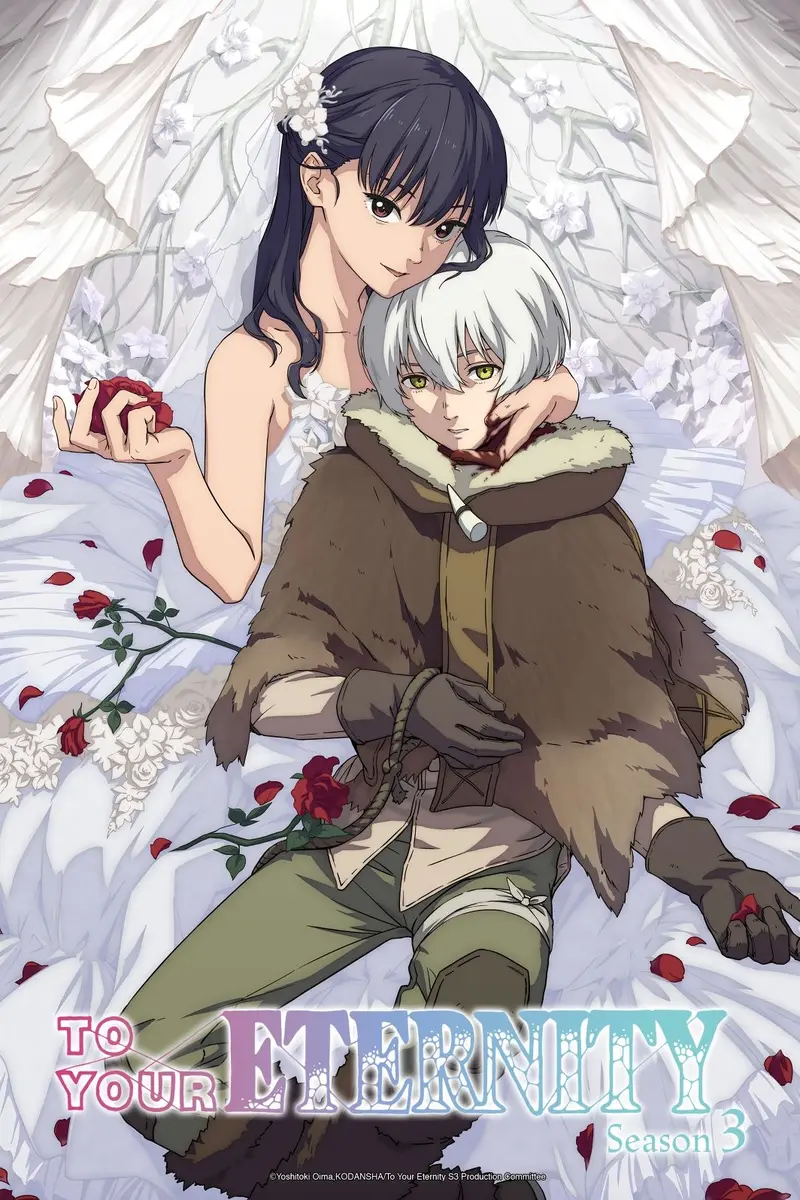
The plot begins like a truce, plants anxiety beneath it, then widens the fracture through Mizuha. She enters not simply as a new character but as an old echo in a new body. Her first look toward Fushi promises that the past is not finished. By linking her to the Yanome line, the story turns lineage into a key for her attraction to Fushi, her inner disorder and her transformation into a battleground among choice, inherited destiny and the Nokkers.
Mizuha is the season's dramatic spine because she asks whether destiny can be broken—whether a person can escape blood, family and fear planted in childhood. Her crisis has layers: self-image, her relationship with her mother, the truth of her identity, the feeling that her life is not hers and Fushi appearing as both rescue and trap. That accumulation makes her turns feel like a psychologically rooted collapse rather than plot machinery.
When mystery weakens the rules
The screenplay weakens when detail has to obey established logic. Why were resurrected friends returned in apparently random places? Why do the rules shift from one case to another? Most importantly, does Izumi's return after death fit what the series previously said about death and passage, or is it a continuity problem? Mystery is one thing; unstable rules are another. A supernatural world can remain unknowable while still preserving the viewer's trust in its laws.
Yet the season knows how to pull a thread. Izumi's death and the version who follows may involve a Nokker, Kahaku or another being like Fushi. The story operates simultaneously as event and interpretation, asking not only what happened but who acted, why, and whether an apparent truth is a mask. At these points linear storytelling becomes a field of possibilities and invites emotional as well as intellectual participation.
Can humans and Nokkers coexist?
Earlier seasons offered a clearer face-off between hero and enemy. Now the conflict is deliberately colored: what if the Nokkers no longer behave like the old enemy, but live among humans, resemble them and seek something beyond direct killing? Through Yuki, coexistence is presented as naïve but not worthless. He represents the uncomfortable question: is battle truly the only answer?
The idea is strong, but the Nokkers' core desire remains too unstable. At one moment they appear to want humans to pass into another state of being; at another they seem intent on occupying bodies and displacing people. Ambiguity can strengthen a villain, but a conflict still needs an intelligible inner logic. Here the antagonists are potent in presence and less convincing in motive.
Fushi's innocence: identity or delay?
The writing is faithful to Fushi and sometimes frustratingly harsh on him. He remains naïve, slow to recognize repeated patterns and late to understand Mizuha's feelings or the danger around him. This innocence belongs to a being who lives for ages but does not mature through a normal human lifespan. When it reveals his alien relationship to experience, it is painful and true.
When repeated too often, however, the same trait makes his choices seem written to prolong a crisis rather than flow from growth. The script wins when innocence wounds him; it loses when innocence merely stalls the plot. This contributes to uneven pacing: a strong opening and idea-rich middle give way to calming episodes, repeated meanings and late emotional peaks that sometimes land below expectation.
Direction and a deceptive calm
The direction chooses delayed unease over immediate shock. School, streets and daily relationships appear ordinary but are framed as though something beneath them has cracked. That is the modern setting's real value: peace itself no longer feels safe, and every quiet moment might be preparation for rupture. The drawback is excess patience; certain scenes and episodes linger until tension loses its edge. The direction is intelligent in atmosphere and occasionally slow in execution.
The animation follows the same idea. Modern cities and schools favor realism and restraint rather than constant spectacle; deformation arrives through the Nokkers and strange transformations. The danger no longer needs to look like a monster—it lives among people and resembles them. That visual function suits the story even if some stretches lack kinetic energy.
Voices carrying the interior battle
Voice acting may be the season's most essential craft because the drama depends on hesitation and inner contradiction. Mizuha's instability is heard before it is seen—in pauses, tension and abrupt changes of state. Fushi's voice likewise balances innocence, ignorance and the strange distance of someone who has lived so long while understanding so little.
Not every supporting character or lighter interlude reaches the same level, but the heavy scenes work because emotion is voiced with precision rather than simply announced. The cast protects the season's heart whenever plotting becomes crowded.
03 / Final verdict
Final verdict
Season 3 is ambitious, sensitive and full of weighty ideas. It succeeds when it writes characters from the inside, binds present to past and makes psychological conflict louder than external noise. It falters when the world's rules blur, motives remain insufficiently clear or Fushi's innocence is used to move the plot. It is neither flawless nor an ordinary extension: there is pain and awareness, beauty and confusion, magnificent flashes and incomplete touches. Its questions carry it—loss, identity, whether love saves or entangles, whether immortality is release or the refusal to accept death. The deepest possibility is that Fushi's salvation may not lie in restoring everyone forever, but in learning to let go and someday find rest himself. That returns the anime to its first truth: life is measured not by its length, but by what it leaves in the heart. The great question still breathes—how does someone who cannot die live in a world where everything leaves?