02 / The review
9 CHAPTERSA crime tied to a broken family
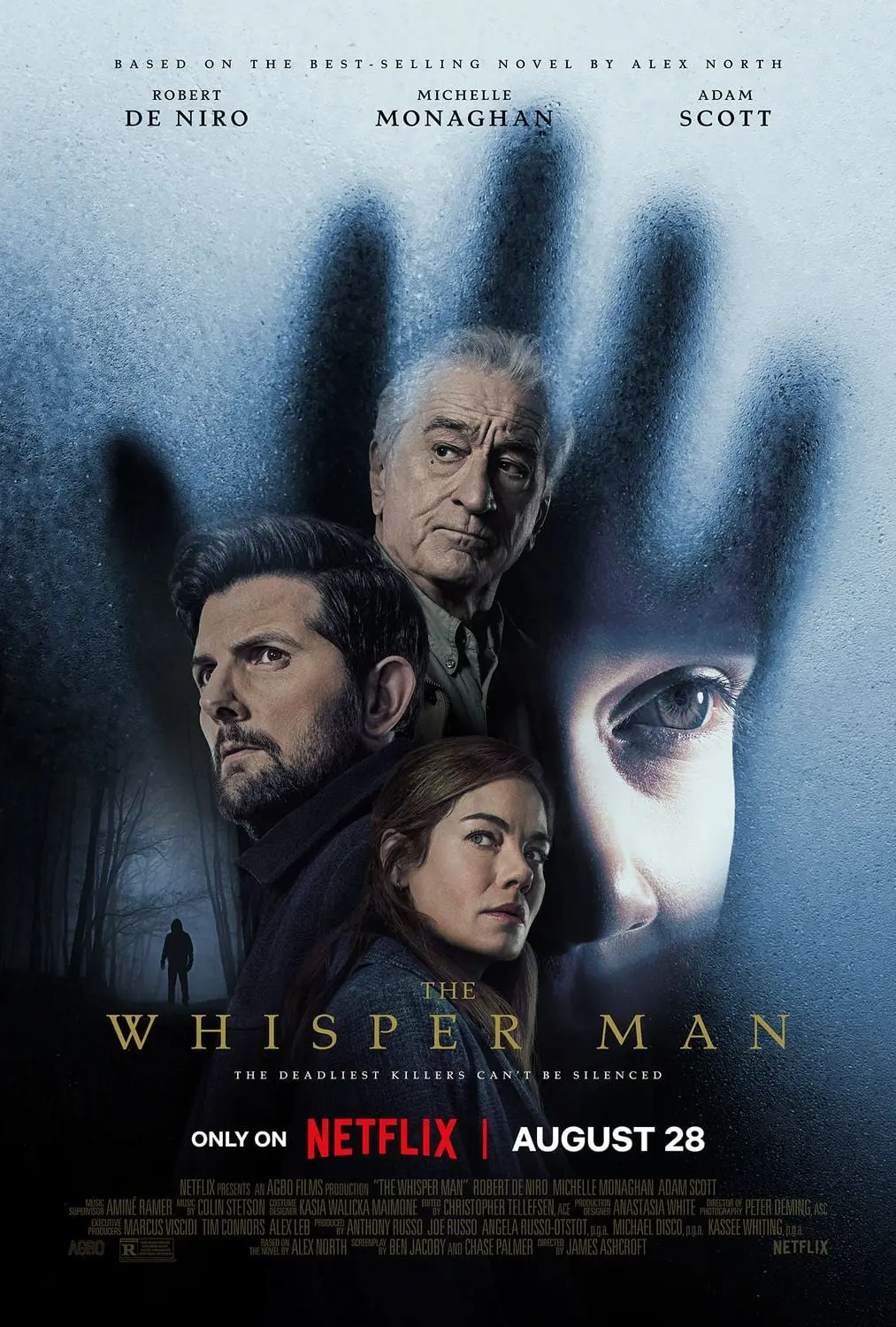
Crime novelist Tom Kennedy moves with Jake to the town where he grew up after the death of his wife. The relocation is supposed to create a new beginning, but a local child disappears and then Jake is taken in circumstances echoing the murders of the Whisper Man.
Tom turns to his estranged father Pete Willis, the retired detective who captured the original murderer years earlier. That is an excellent foundation because the case is immediately connected to a damaged father-son relationship rather than operating only as a hunt for a killer. Unfortunately, the film never gives that relationship enough space to become truly affecting.
Tom begins repeating his father's mistakes
Tom has spent years believing Pete chose police work over his family. Pete's obsession with the old case made him an absent father and left his son carrying a resentment that never healed. After Rebecca's death, history starts to repeat in a different form.
Tom is physically present with Jake, but he does not always understand his son's grief. The scene in which he loses patience over Jake's imaginary friend is important because it reveals a flawed father, not an ideal protector. Jake feels alone even while his father is beside him. That could have supported an entire film, but the screenplay quickly reduces the child's loneliness to a mechanism for the kidnapping plot.
Pete wins the case and loses his family
Pete is potentially the film's richest character: a detective who solved the Whisper Man murders at an enormous personal cost. Saving his grandson gives him one final opportunity to repair something with the son he neglected.
The metaphor is obvious but effective: rescuing the grandson becomes a late attempt to rescue the father-son bond. Yet the screenplay provides too little dialogue and too few lived details between Pete and Tom. We are told their relationship is broken, but we rarely feel the weight of the years that broke it.
Adam Scott and Robert De Niro never fully meet
Adam Scott is effective when Tom's grief and fear become anger. The character has enough pain on paper, but the script gives him familiar psychological details without the dialogue needed to bind them into a complete person.
Robert De Niro plays Pete with restraint. In theory, that quietness belongs to a man who hid emotion behind his work for decades. In practice, the contrast between the two performances sometimes makes father and son feel as though they occupy different films. The silence should be loaded with shared history, but too often it feels like missing dialogue.
Violence survives through inheritance
The film's second major idea is that a killer's influence does not end when he enters prison. It can survive through people shaped by him. Francis Junior creates a criminal mirror of the central family: fathers leave consequences behind, and sons inherit damage they never chose.
This is the thematic structure that gives the movie its best depth, but the revelation arrives late and the drama has not prepared enough emotional ground for it. We understand the parallel intellectually without feeling it with equal force.
Michael Keaton gives the prison scenes life
Frank Carter, the original killer, is one of the few characters who instantly electrifies the film. Michael Keaton gives him sarcasm, arrogance and a provocative energy that makes his limited prison scenes among the most compelling parts of the story.
Frank still tries to control the investigators through the information he owns and takes pleasure in shaping how they understand the case. His presence exposes a larger weakness: the supporting characters sometimes possess more dramatic life than the father and son meant to carry the movie.
True-crime obsession without enough consequence
Norman Collins is obsessed with serial killers and collects objects connected to their crimes. Through him, the movie briefly asks when fascination with true crime stops being curiosity and becomes an unhealthy form of possession that forgets the victims.
Norman treats a human tragedy like a collection. The observation is sharp, but it remains largely detached from the film's emotional center. Once again, an interesting idea is introduced without becoming a fully integrated part of the story.
Jake's imaginary friend reveals the real need
The revelation that Jake's imaginary companion is an image of his mother Rebecca gives the ending one of its most humane ideas. What initially appears supernatural becomes connected to the child's private method of surviving grief and fear.
The girl in the blue jacket can be understood as an extension of Jake's survival instinct: a mental image of the mother who offers safety when his father cannot. The ending finally directs Tom toward what he missed—Jake needs more than physical protection; he needs a father capable of understanding his grief.
Atmosphere gives way to routine investigation
The early direction uses the house, storms, empty rooms, doors and windows to make domestic space feel unsafe. The threat seems embedded in the place where father and son should be able to recover.
Once the story expands into a standard police investigation, that pressure weakens. Suspects, interviews and new information divide the focus, while the psychologically charged house becomes just another location. The procedural mechanics overpower the human drama the film was best equipped to tell.
03 / Final verdict
Final verdict
The Whisper Man is not a film without ideas. Its problem is that those ideas are better than the finished movie. It could have been a powerful story about a father realizing he is repeating his own father's failures, a child trying to survive grief and loneliness, and violence moving from one generation to the next. Instead, the police mystery overwhelms the emotional material and turns several strong themes into pieces of a conventional puzzle. The film works best whenever it stops chasing the next revelation and pays attention to family, loss and absence. It has a promising beginning, several striking performances and a central idea deserving of a better film, but it never combines them into a consistently affecting whole.
Your turn