02 / The review
7 CHAPTERSA big opening attached to a smaller mission
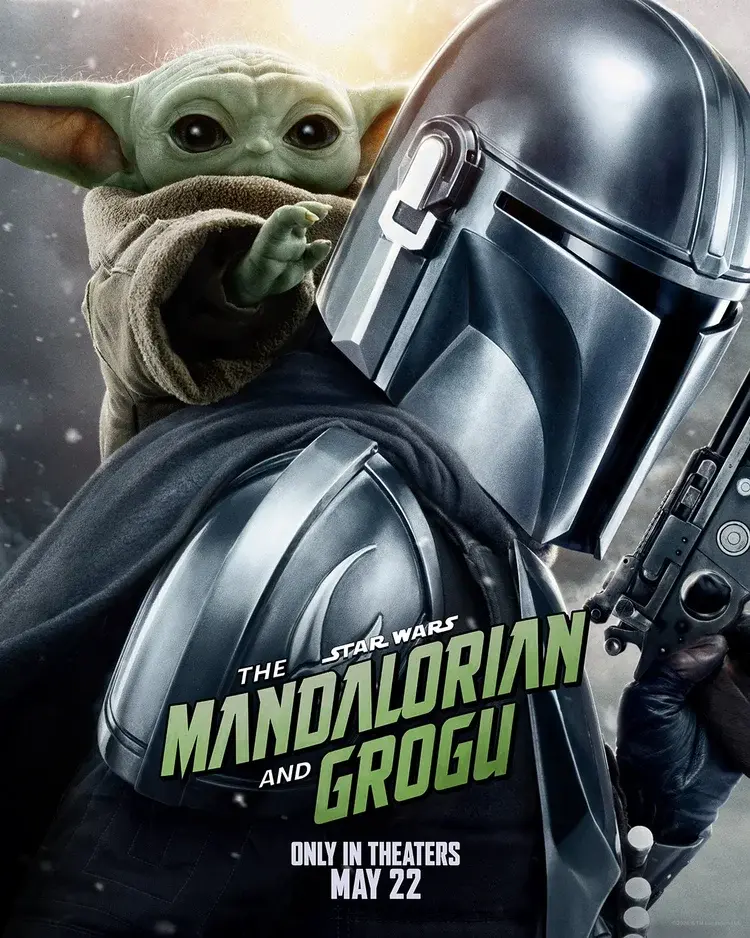
The assault on Commander Barro's Imperial gathering is direct and cinematic: snow, AT-ATs, pursuit and a Mandalorian who wastes no time. Grogu already behaves as a partner rather than luggage. The sequence establishes physical scale, but it remains curiously detached from the emotional and narrative centre that follows.
Colonel Ward wanted Barro alive for intelligence and sends Djarin after Commander Coin. That trail leads through the Hutt Twins to their missing nephew Rotta, turning a galactic political premise into an eccentric rescue assignment. The movie does not fail to tell that story. It simply reveals very early how safely it intends to play.
Rotta steps out of Jabba's shadow
Rotta is no helpless captive. Jabba's son has become a muscular arena fighter on Shakari, an initially bizarre image that grows surprisingly enjoyable. He knows his aunt and uncle want him removed because his inheritance threatens their rule, but he rejects the throne as well. He wants an identity not defined by Jabba.
The idea gives him more than visual novelty, even when his dialogue states the theme too directly. His gentler connection with Grogu is one of the film's pleasures. Star Wars is at its best when even its strangest creatures are permitted a small, recognisable humanity.
A beloved bond that barely changes
Din Djarin and Grogu remain the strongest reason to watch. The quiet armoured father protects the tiny apprentice, and the child finds brave, awkward ways to return that protection. Their shared danger and understated warmth still work after three seasons.
But affection is not development. The film touches its richest idea—that Grogu will outlive Djarin by a vast span, and that every act of parenting therefore carries future grief—then retreats to action and reassurance. It has a deeper heart than it allows itself to expose. That is its greatest emotional waste.
An episode-shaped feature
The plot advances from one assignment to another: find Rotta, expose Lord Janu as Commander Janu Coin, deliver him to Ward, survive Embo, escape the Hutts, rescue Djarin and return for Rotta. Snow, Nal Hutta, Shakari, arena and swamp provide variety, but each setting feels like a separate level in a long episode.
No single danger rises relentlessly from beginning to end, and none of the central characters undergoes a major transformation. Mando remains Mando, Grogu learns a little, and Rotta's decision to work with the New Republic is pleasant rather than seismic. The structure is easy to enjoy but never becomes epic.
Villains, helmets and missed consequences
Lord Janu connects crime to the Imperial remnants and gives the plot a functional antagonist, but not a memorable one. Embo creates greater immediate danger by defeating Djarin and forcing Grogu to operate alone. The Hutt Twins then strip Mando of his helmet, attacking not only his body but his creed and self-image.
The helmet violation should be a defining wound, yet the film rushes toward the creature pit and the Dragonsnake. There is little time for humiliation, rage or consequence. It is one more example of a strong dramatic door opened only for the story to sprint through the next one.
Grogu alone and the value of quiet
When Djarin is poisoned, Grogu becomes the actor rather than the companion. He hides, searches for treatment and meets the Gatori who helps him save his guardian. These quieter passages are more truthful than some of the large battles because the child's tiny movements and restrained fear carry clear emotional stakes.
The Anzellans add practical charm, and the swamp lets puppetry, texture and creature detail breathe. By contrast, some arena and interior action is dark, crowded and cut too quickly to establish geography. The film repeatedly proves that one clear moment with Grogu can matter more than an expensive fight whose details are difficult to read.
Comfort, nostalgia and the cinema question
X-wings, a new Razor Crest, Hutts, bounty hunters, arenas and New Republic missions make the galaxy feel immediately familiar. Nostalgia is not offensive here; it is a warm safety blanket. The problem is that the film uses familiarity more often to reassure than surprise.
There are widescreen images, forceful music and action that justify a theatre in isolated moments. The narrative itself remains televisual. A feature needs more than beloved characters and an enlarged frame; it needs risk, change and a reason this particular journey could not have remained another episode.
03 / Final verdict
Final verdict
Star Wars: The Mandalorian and Grogu is warm, entertaining and easy to like, but not large enough. Its best material belongs to Mando and Grogu together—and to Grogu when he must act alone. Its weakest choice is to play so safely that neither characters nor galaxy truly move. Fans of the pair will find a polished adventure; viewers waiting for a major cinematic event may find a small mission wearing a large costume. The film proves that this relationship can carry a story. It also proves that affection alone cannot supply the danger, transformation and ambition cinema needs.