02 / The review
9 CHAPTERSOne game carrying many lives
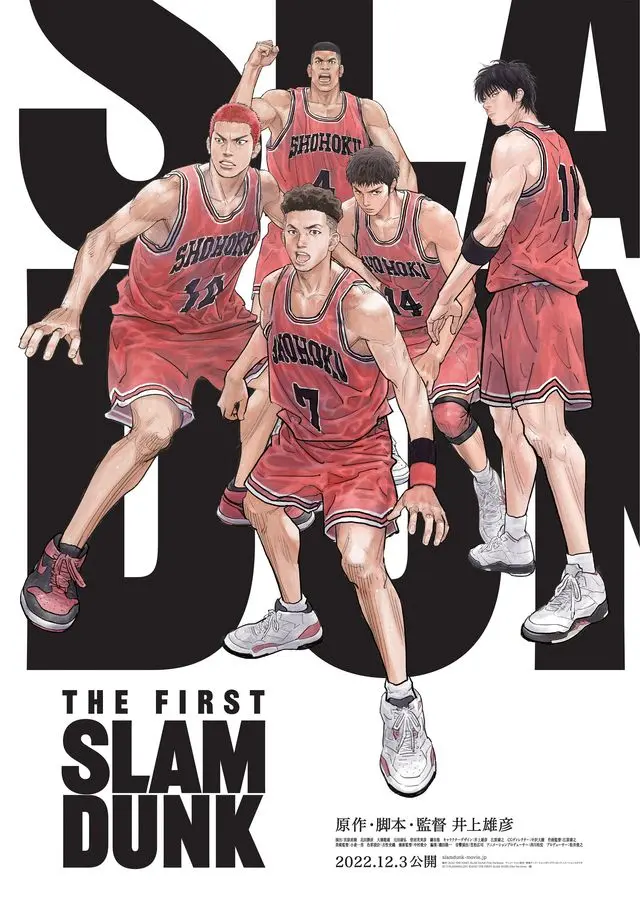
The premise is extremely simple: underdog Shohoku faces Japanese champion Sannoh. Behind that simplicity, the screenplay creates a layered experience in which the immediate sporting event and the emotional burden of memory continually reshape one another.
The film treats fundamentals as a dramatic principle. Like basketball itself, the writing moves between showmanship and discipline, balancing direct excitement with patient character work instead of allowing either side to consume the other.
Present action and past memory
The narrative uses two timelines: the unfolding Shohoku–Sannoh game and fragments from each player's past. The match is not a decorative frame; it is the spine from which every memory hangs. A pause, failure or moment of pressure opens a window explaining the present.
Most flashbacks avoid becoming filler because they directly change how we understand a decision on the court. The past is not a detour from the match; it is an invisible participant in every second of it.
Ryota becomes the emotional center
The most important writing decision is to move the center from Hanamichi Sakuragi to Ryota Miyagi. The shift gives the film a more mature, mournful tone than the series' familiar comic energy.
Ryota carries the loss of a gifted older brother, a childhood built on admiration and an accident that cuts the relationship short. Basketball becomes more than a dream; it is psychological survival. The screenplay explains his persistence, solitude and fear without excessive monologues, trusting silence and incomplete memories.
Familiar archetypes, efficient characterization
The rest of Shohoku includes recognizable sports-drama types: the lazy player who finds passion, the troublemaker rebuilding himself, the captain carrying everyone and the silent star with absolute confidence. These patterns are not original.
The strength lies in restraint. The film suggests more than it explains and condenses instead of summarizing an entire long-running series. Several characters could use more depth, but the screenplay rarely drowns the match under biography.
Sannoh are rivals, not villains
Even Sannoh, particularly Eiji Sawakita, receives enough humanity to resist the easy division between heroes and villains. The opposing team feels pressure, ambition and disappointment too, grounding the sports conflict in recognizable competition.
The two-hour length can become tiring as patterns of play recur despite changing dramatic angles. The screenplay occasionally loses economy, but knows precisely when it must regain control for the final movement.
A final minute that stretches time
The final minute is a remarkable dramatic climax. Dialogue almost disappears, sound contracts and time expands. One second carries the weight of a whole life as the viewer enters the players' concentration rather than merely watching the score.
This is not only a sporting victory. It is the culmination of two hours of grief, discipline and identity. The moment feels like a memory forming in real time, which explains why its impact extends beyond the result of the match.
Direction that makes the match lived experience
In his directing debut, Takehiko Inoue concentrates less on what happens than on how it feels. The camera breathes with the players and enters the court through impossible angles, abrupt changes of distance and images shaped by pressure rather than physical realism.
Carefully placed silence is equally important. In the climax, music and dialogue withdraw so natural sound and the slowing perception of time can dominate. Time itself becomes a dramatic element.
2D warmth and 3D movement
The blend of 2D art and 3DCG is a visual risk that becomes a strength. Daily life retains clean, warm drawing connected to the series' legacy, while the court uses three-dimensional models for rotation, acceleration, jumping and convincing physical contact.
The models preserve visible lines, sweat and bodily weight instead of becoming cold digital objects. Motion-capture influence gives the game an NBA-like flow, while animation allows viewpoints no real camera could sustain.
Voice acting built on restraint
Shugo Nakamura gives Ryota an inward, tense performance carrying more weight than the character's age suggests. The rest of the team is distinctive without becoming caricature, and the opponents sound like players living the same pressure rather than generic enemies.
Breathing, short cries and heavy pauses become as meaningful as spoken lines. One dated weakness remains in certain racial descriptions and nicknames inherited from the source. Fidelity is understandable, but those details could have been updated without damaging the film's spirit.
03 / Final verdict
Final verdict
The First Slam Dunk does not reinvent sports anime; it concentrates its essence. It welcomes newcomers, rewards longtime fans and stands as a complete emotional experience. Some character types are familiar and the length occasionally repeats itself, but the film passes its most important test: it makes one basketball game feel like a life-defining memory.