02 / The review
8 CHAPTERSA city that remembers the mask
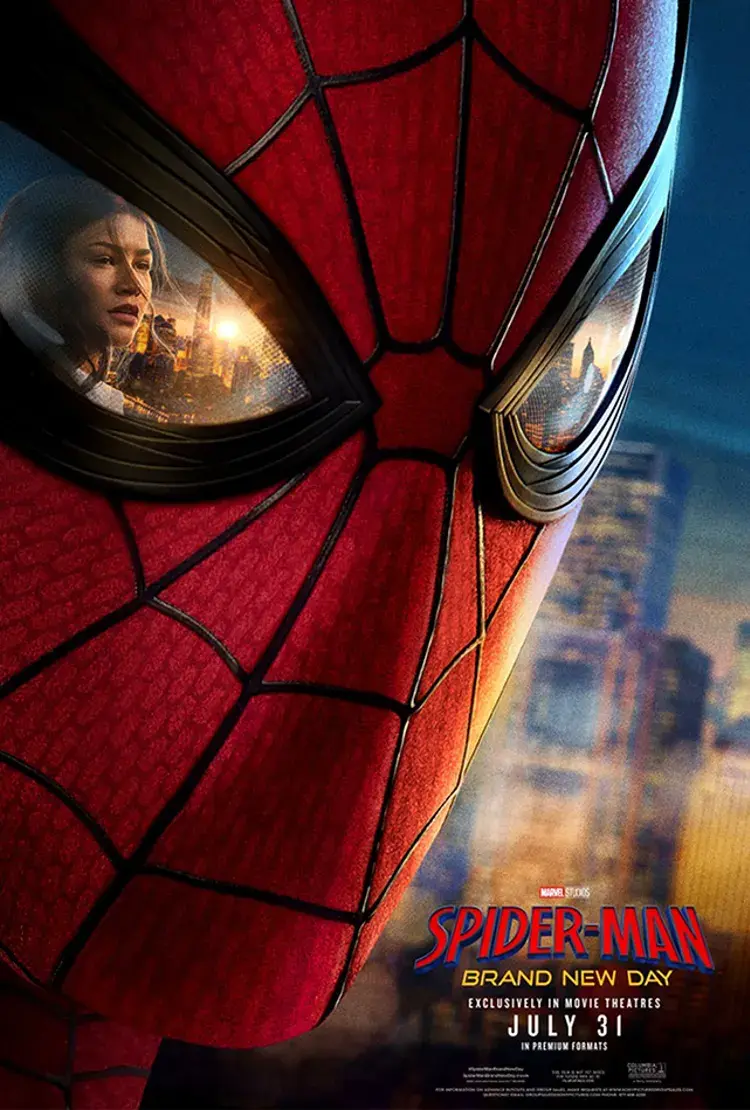
The most affecting material comes from Peter's life four years after No Way Home. Everyone has forgotten Peter Parker, but everyone still knows Spider-Man. It is a cruel paradox: the city keeps the part of him it needs while his private life has almost completely vanished. MJ and Ned move forward; Peter turns himself into Spider-Man nearly all the time.
He does not fight crime only to help people; he uses heroism to avoid having a life. The film's sharpest insight is that Spider-Man may no longer be the part that saves Peter, but the part that consumes him. The changes in his body make that conflict physical: his abilities intensify, his senses become more violent and his own body begins to revolt. The more the human Peter disappears, the stronger the other side becomes.
Tom Holland's most mature Peter
Holland benefits enormously from this older version. The performance is no longer built around comic nerves and rapid-fire sarcasm. Peter even moves with more weight; exhaustion lives in his body, and at times he seems unsure what to do when he is not wearing the mask.
One of the simplest and best moments has him watch Ned's life from a distance, close the screen and return to his suit. No dialogue is needed. He knows there is a life he might have shared, yet chooses not to approach it. Crucially, the film does not frame that choice as noble sacrifice alone. Peter has made isolation into a way of life, and Holland is excellent as a man who convinces himself that constant activity means he is fine. It may be the richest dramatic material he has received as Peter Parker.
MJ, Ned and the cost that must remain
Peter's scenes with MJ and Ned are among the film's best precisely because they require no battle. He can stop a tank and face the Hulk, yet cannot enter a room and speak naturally to the two people who once knew him best. The film wisely refuses to restore MJ's memories as though No Way Home never happened. When she learns what she meant to Peter, she cannot simply resume a relationship she does not remember. His memories belong, from her perspective, almost to someone else.
That is why Peter's declaration of love, and her inability to return it, hurts while remaining completely logical. Zendaya conveys the sense that something about him feels strange and familiar without knowing why. The earlier kiss and the revelation of Jean's interference make it crueller still: even when Peter receives something resembling an emotional confession, he cannot trust it.
Ned has less weight, but he represents Peter's old life from another angle. The closing suggestion that some memory could return is intriguing, though the next film should resist an easy reset. No Way Home mattered because Peter paid a real price.
Jean Grey as Peter's mirror
Sadie Sink's Jean Grey works because she is not merely a new villain for Spider-Man to defeat. Jean mirrors Peter: both live with loss, isolation and power that is difficult to control. The difference is that Peter once had Aunt May to teach him how to carry power, while Jean's abilities grew amid fear, anger and grief. The truth about her search for her sister Sara and what Metzger did reframes everything we have seen.
Sink makes the anger visible, but the fear beneath it matters more. When Jean loses control, she does not feel like a villain who woke up wanting to destroy a city; she feels like a young woman who no longer knows what to do with her pain or power. My problem is not Peter's attempt to save her rather than beat her into submission—that is exactly right for him—but the speed with which their long-built conflict turns into understanding. The emotional confrontation needed more room.
Accepting the whole self
The best part of the final encounter is not the action, but Peter realizing that he has treated himself the wrong way. Throughout the film he suppresses his evolving powers with an inhibitor because he fears becoming something he cannot control. Yet the answer is not choosing Peter Parker or Spider-Man. He is both. The problem was never simply that his abilities grew stronger; it was that Peter himself disappeared.
Removing the inhibitor therefore means more than becoming stronger. He stops treating part of himself as a monster that must be imprisoned, an idea that elegantly connects his story to Jean's. When she enters his mind and sees Aunt May's memory, Peter does not lecture her; he lets her witness what once helped him continue. Then he steps in front of Frank Castle's bullet to save her, turning belief into action. Jean's decision to save him becomes her first truly outward act after spending the film driven by her own anger and pain.
Their bond works best as recognition between two wounded people, not the start of a romance. The film does not need to turn it into anything else.
Control as the real antagonist
Bill Metzger represents a different kind of adversary. He needs no superhuman ability; he simply believes everything can be contained and controlled. That fits the film's central theme. Peter uses a device to control himself. Damage Control uses prisons and technology to control powered people. Metzger takes that logic to its ugliest destination.
I only wish the writing gave him a stronger personality beyond his function. His disappearance and the future of the inhibitors are clearly seeds for later stories. That exposes a recurring problem: some elements belong to this narrative, while others feel present because Marvel will need them later.
Punisher, Banner and competing ideas of heroism
Jon Bernthal is enormously entertaining as Punisher, and the contrast with Peter feels organic. Frank treats violence as a direct solution; Peter always searches for another path. Their scenes work not just because of the banter, but because they embody incompatible visions of heroism. Frank's final shot puts his philosophy against an immediate result: he chooses to end the problem, Peter chooses to save the person Frank calls the problem, and Peter pays the price.
Bruce Banner is a logical person for Peter to seek out: both fear an inner side they cannot control. The film, however, cannot resist turning that meeting into a giant Hulk confrontation. The sequence has scale and lets Spider-Man's speed play against raw strength, but it is not what I will remember first. At times both Frank and Bruce lean on audience familiarity instead of being fully built inside this story.
Too many doors left open
A tank, Scorpion, Punisher, The Hand, Hulk, Damage Control, Yelena and Jean Grey: there is a great deal of good material here, but the number of components keeps some of them from becoming truly great. The film repeatedly begins something exciting and moves away before it can deepen.
At roughly 145 minutes, Peter's journey still does not move as far as expected. He begins alone and ends less alone, but remains near the same basic position. His relationship with himself changes; Jean enters his life; MJ knows the truth; something stirs in Ned. Those are meaningful steps, yet the film carefully preserves nearly every piece for later. The inhibitor postpones the full consequence of Peter's evolution, Jean opens a larger world, Metzger vanishes, Damage Control remains unresolved and the final scene looks toward space.
I do not object to setup. But a strong film must first satisfy me with the story I just watched, then make me anticipate the next one. Brand New Day sometimes appears more invested in what follows than in completing what is in front of it.
03 / Final verdict
Final verdict
A very good step forward for Tom Holland's Spider-Man, though not equally strong as a complete film. Its best decision is to take the end of No Way Home seriously: Peter did not merely lose his friends; he lost his life, then tried to persuade himself that Spider-Man could replace it. Holland is excellent, the MJ material is moving, Jean Grey is a successful addition and the darker visual identity suits this stage of Peter's life. Whenever the film leaves Peter to service too many characters and future projects, its focus slips. I enjoyed it and think it lays an excellent foundation for the next Spider-Man—but I wish it had trusted its central story enough to give it more space.
Your turn