02 / The review
6 CHAPTERSBear's wish and the violence of entitlement
Bear has loved Nikki, his childhood friend, for years. When she gives him an opening to speak honestly, he freezes and retreats. Instead of risking rejection, he buys the One Wish Willow and asks for certainty. That weakness is not a harmless quirk; it is the moral origin of the tragedy.
Bear is not a conventional villain, but he is not innocent. He mistakes years of kindness and proximity for a claim upon Nikki's heart. By using the wish, he avoids forcing her with his own hands while still stealing her choice. The film refuses the comforting idea that a ‘nice’ man is owed an emotional reward.
Nikki, the victim inside the monster
The film is smart enough not to reduce Nikki to the stereotype of the jealous, deranged girlfriend. Beneath the eerie smiles, surveillance and escalating violence, another Nikki remains trapped. She resists, hurts herself and begs for help, at one point asking Bear to kill her in her sleep rather than leave her imprisoned inside a stolen body.
Inde Navarrette effectively performs two people in one body: the loud, impulsive and free Nikki, and the wish-made version whose affection has become programming. We fear what she does while understanding that she is the real victim. The most revealing line comes when Bear asks what is so bad about being with him; even at the centre of the catastrophe, he still imagines himself as the injured party.
Love without freedom becomes horror
The entire film turns on one question: what would happen if you could make someone love you? Its answer is merciless. You would receive not love but a diseased copy—without choice, honesty or soul. Every romantic gesture is therefore contaminated. A kiss feels like a body moving against its own spirit.
That inversion gives the film more weight than a simple tale about a magical object. Not every silent love is noble, and not every long wait is proof of virtue. Affection requires the possibility of refusal. Remove that possibility and intimacy becomes confinement.
A slow infection of ordinary life
The wish does not transform Nikki into a monster in a single beat. The escalation moves from odd to disturbing to terrifying: a bizarre memorial for a dead cat, lies about a sick father, unnatural jealousy, watching Bear sleep, then violence and murder. The gradual construction makes the horror resemble a disease spreading quietly through a home.
Long looks, smiles in the wrong place, taped doors and corrupted domestic routines make familiar rooms unsafe. The film is strongest when it lets discomfort accumulate. It does, however, hold certain beats for too long and occasionally repeats the same anxiety before moving forward. The slow burn suits the idea, but a tighter cut would have made it sharper.
From romantic comedy to blood
One of the film's best tricks is its gradual mutation from awkward romantic comedy into bloody horror. A childhood crush, a teasing friend, a failed confession and a strange gift all seem to belong to a quirky romance. Then affection becomes pursuit, jealousy becomes murder and the home of confession becomes a room full of bodies.
Sarah's death is especially brutal because she represents a possible life built on free affection—a road Bear might have taken without magic or coercion. Practical effects and makeup give the moral collapse a physical cost. The blood is not decoration; it is the visible consequence of Bear's refusal to respect Nikki's freedom.
The Willow, the ending and the price
The curse can end only with the death of the person who made the wish. That rule gives the finale a grim logic: Bear himself is the root, and the wish remains alive while he does. Nikki returns to herself when he dies, but she does not get her life back. She wakes amid bodies and ruin she did not freely create, yet whose consequences she must carry.
The film keeps the origin of the One Wish Willow and the company behind it deliberately vague. That uncertainty makes the curse more arbitrary and frightening, though a few more hints about its rules might have enriched the world. It is an obvious door to future stories, provided later films keep their focus on human weakness rather than treating the object as franchise machinery.
03 / Final verdict
Final verdict
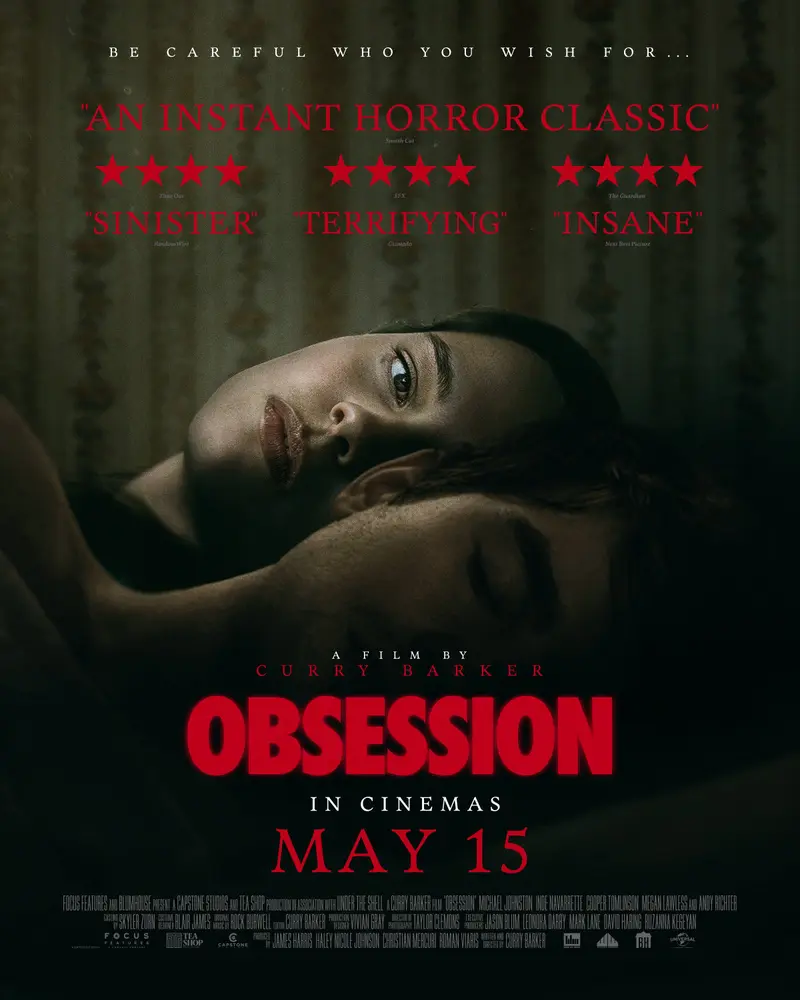
Obsession is a good, disturbing horror film built around an uncomfortable truth: affection that does not arrive freely does not deserve to be called love. It does not absolve Bear or reduce Nikki to a monster; it enters the harsher territory where the victim becomes dangerous and the wish-maker remains the cause. The film is sometimes slow and predictable, but its central idea, two committed performances, practical effects and appropriately bleak ending stay with you. Never wish to own another person's heart. A heart without freedom brings ruin with it.