02 / The review
10 CHAPTERSA familiar revenge machine
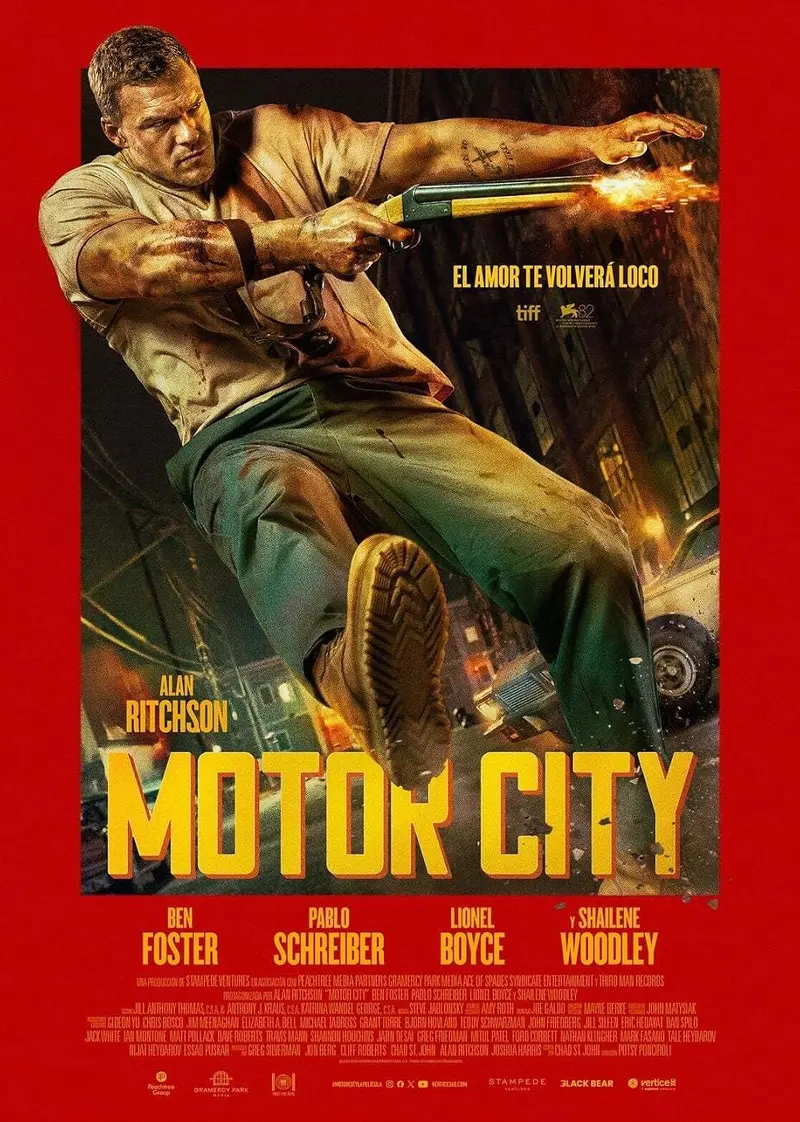
The basic machinery is immediately recognizable: a man trying to build a new life, the woman he loves, a violent enemy who destroys that future, a fabricated charge, years in prison and a return devoted to settling the score. Alan Ritchson's John Miller lives in Detroit in 1977 and is attempting to leave his criminal past behind. Sophia represents his best chance at an honest beginning.
Reynolds, played by Ben Foster, drags John back into violence by planting drugs and using corrupt police connections to frame him. The plot is not innovative, and the film makes no effort to pretend otherwise. Simplicity is not the real problem. The weakness appears when this familiar structure needs richer characters and relationships to make its emotional turns convincing.
Silence as a language—and a limitation
Motor City's greatest risk is also its greatest strength. With only a handful of spoken lines, actors cannot simply explain emotion and the screenplay cannot deliver information through ordinary exposition. Meaning has to travel through movement, facial expression, posture, music, sound effects and editing. John never needs to announce his anger. The way he walks, holds a weapon or fixes his gaze on another person tells us that something inside him has changed.
The approach makes the experience genuinely distinctive and pushes John toward the archetype of the old action hero whose body is the main instrument of expression. It also carries a cost. Removing dialogue does not only remove words; it removes a major space for motivation, psychology and relationship building. Motor City consequently succeeds more completely as visual cinema than as character drama.
Alan Ritchson carries the film through his body
Alan Ritchson is well suited to a role like this. John is naturally reserved, but Motor City pushes that quality to its extreme, forcing Ritchson to rely almost entirely on physical presence. The way he carries a gun, his heavy walk, controlled expression and prolonged stare all become pieces of character writing. Crucially, Ritchson does not compensate for the missing dialogue with exaggerated acting.
He presents John as calm on the surface and packed with accumulated rage underneath. That fits a man who does not return from prison in pursuit of legal justice, but because revenge has become his only reason to continue. The same restraint can flatten him, however. We understand his actions and anger, yet the film does not always provide the psychological depth that would make his journey truly painful rather than merely forceful.
Ben Foster gives the story its spark
Where Ritchson works through stillness, Ben Foster moves in the opposite direction. Reynolds is nervous, volatile, unstable and violent, and Foster pushes those traits hard. The contrast serves the film: John is silent force, while Reynolds is chaos in motion. His smile, sudden explosions and inflated confidence make every appearance uncomfortable and entertaining at once.
Foster prevents Reynolds from becoming only a functional gangster. The character remains interesting because he can appear pathetic at the same time he appears dangerous. That contradiction gives the villain an energy the hero sometimes lacks, precisely because John's near-total silence restricts how much personality he can project beyond rage and purpose.
Sophia is the story's weakest link
Sophia is supposed to be the emotional foundation of John's entire campaign, but she is never given enough room to become a complete person. Her return to Reynolds after John is imprisoned is especially difficult because the screenplay does not make the transition persuasive. She believes John betrayed her after drugs are found in his car, and her shock and anger make sense, but her rapid movement into Reynolds's life feels designed for the plot rather than born from the character.
That weakness damages the emotional payoff. The film wants Sophia's death to ignite John's final revenge, but the moment could have carried far more weight if Sophia had been written with an inner life and trajectory of her own. Instead, she becomes the center of a conflict between two men more often than she becomes an active character in her own story.
Action gives Motor City its confidence
Motor City becomes much more assured whenever it turns fully toward action. The fights are carefully designed and every impact has weight. Rather than depending only on gunfire, the film frequently turns the location itself into part of the choreography. The elevator confrontation is the clearest example, using strange angles and constant motion to prove that missing dialogue means nothing when physical storytelling is strong enough.
Violent encounters in and around cars, along with the chases, supply the energy the film needs. This is the clearest explanation for why the experience remains entertaining despite the thin story. Motor City is not selling an intricate plot. It is selling motion, atmosphere and revenge, and on those terms it achieves its goal.
An ending that belongs to another tone
The ending is my largest reservation. For most of its running time, Motor City establishes a clear tonal contract: violence, revenge, heightened imagery and a simple story played seriously inside its own world. The final movement shifts that contract. Reynolds unexpectedly survives the climax, and the film jumps years ahead to find him old, weak and living another life. John then appears, still carrying the revenge across all that lost time.
The idea is defensible. It demonstrates that John could not release the past and that Sophia's death became a permanent engine in his life. The execution, however, feels more contrived than everything that precedes it. The last confrontation leans toward direct melodrama, breaking some of the disciplined visual tone that had made the journey effective.
Revenge becomes the final prison
Beneath the simple plot sits one coherent idea: revenge does not finish when the hero reaches his target. It becomes the only thing capable of defining him. John loses Sophia, years of his life and his friends, yet remains imprisoned by one moment in the past. The time jump, whatever its dramatic problems, is important because it reveals that the sentence never truly ended when he escaped prison.
John does not truly win. He accomplishes what he set out to do, but spends a vast portion of his life pursuing the man who destroyed it. Motor City therefore presents revenge less as a path toward healing than as a force that keeps a person moving after every other reason to live has disappeared.
Detroit rendered as a violent graphic novel
Director Potsy Ponciroli approaches the near-silent concept with visible confidence. Because dialogue is almost absent, imagery must carry the narrative. Detroit in 1977 becomes a hard, rain-soaked city filled with shadow, neon, old cars and filthy interiors. The film is less interested in complete historical realism than in creating a heightened cinematic memory of the city.
Several sequences look as though they were pulled from the panels of a graphic novel rather than photographed from ordinary life. The choice fits perfectly. Motor City does not aspire to be a social drama about Detroit. It wants the raw pleasure of a B-movie revenge picture, but one made with a deliberate visual intelligence.
When music becomes dialogue
In a film built around the absence of speech, music becomes essential rather than decorative. The seventies songs establish the period but also carry dramatic meaning. They can lend warmth to brief moments of happiness or create a disturbing conflict between gentle sound and violent imagery. A calm song placed over a torture scene is one of the best choices because the comfort of the music makes the image feel even more brutal.
The reliance occasionally becomes excessive. Some scenes seem to continue primarily so a song can reach its end. At those moments, music stops functioning as a narrative instrument and begins dictating the pace, turning one of the film's most distinctive strengths into another source of drag.
03 / Final verdict
Final verdict
Motor City understands its strengths and uses them well. It is not an inventive revenge story, but its decision to reduce dialogue to almost nothing and rely on images, music and physical performance creates a genuinely different action experience. That formal choice keeps the film entertaining and distinctive even when the writing cannot match the promise of its visual style. Alan Ritchson carries John through restraint and physical authority, while Ben Foster supplies the volatile spark that gives the film its most watchable energy. Sophia remains a serious weakness, and the ending is less convincing than the journey toward it. Motor City is neither deep nor revolutionary, but it is bold, stylish and enjoyable. Its success comes from form, rhythm and atmosphere far more than from story.
Your turn