02 / The review
8 CHAPTERSA prison that mirrors society
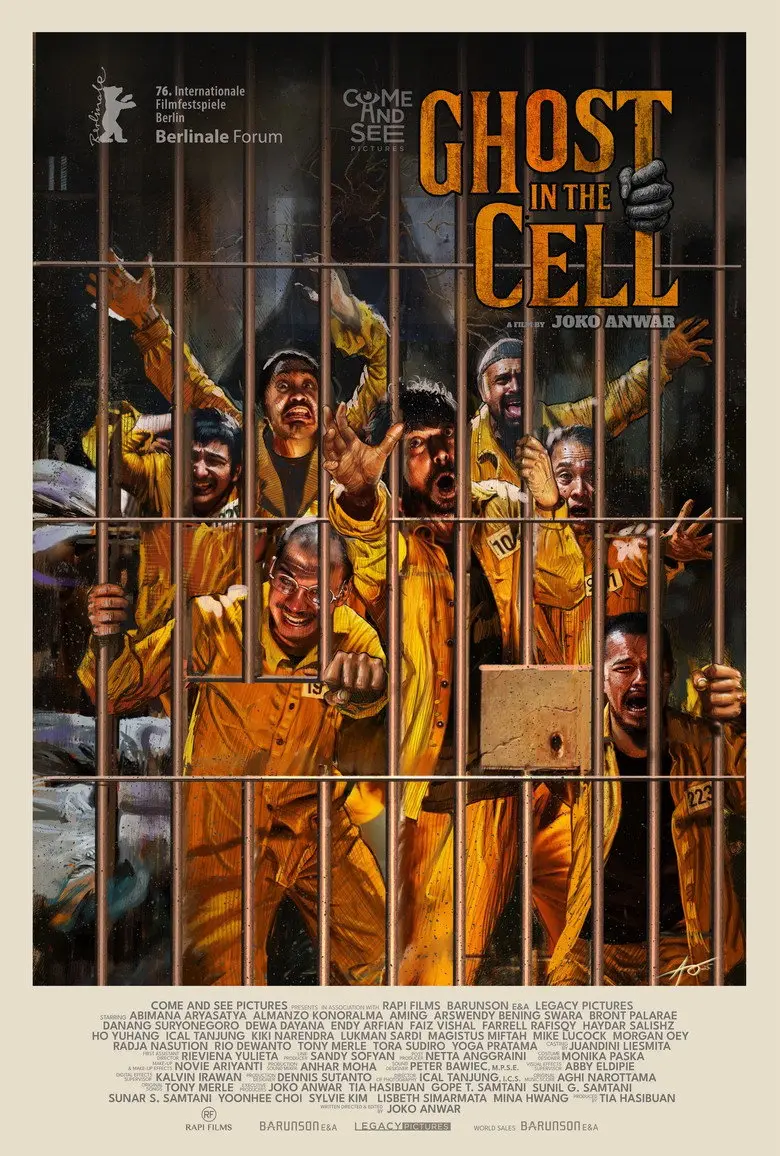
Labuan Angsana is more than a backdrop. It is a compressed social order containing ordinary prisoners trapped in brutal conditions, privileged inmates treated by different rules and guards who turn authority into abuse. The film's central observation is simple and effective: the law does not apply equally to everyone.
These ideas emerge through the contrast between cell blocks, corrupt officers and normalized violence rather than through a heavy political lecture. The satire, sharp exchanges and supernatural events allow the viewer to connect the prison hierarchy with the world outside it.
Anggoro gives the chaos a human center
Anggoro, played by Abimana Aryasatya, provides the story's strongest human anchor. He is not a superhero and the film does not pretend he is morally spotless. He is a forceful prisoner trapped inside a violent system and pushed into direct conflict with Jeffri, a guard who treats power as permission for cruelty.
Aryasatya has the physical authority needed for the fights, but he can also soften Anggoro whenever the film shifts into comedy. Keeping him as one member of a varied ensemble, rather than allowing him to dominate every scene, makes the prison conflict feel more alive.
Dimas enters through journalism and corruption
Dimas begins as a journalist investigating illegal mining in Borneo. The opening efficiently establishes the film's tone: he wants to expose a serious reality while his editor wants something sensational and commercially attractive. That conflict turns horrific when the editor is murdered by an invisible force and Dimas is blamed.
The irony is strong: a man trying to reveal institutional violence from the outside is accused of murder and thrown into the institution whose secrets journalists struggle to expose. Yet the film leaves this thread suspended for too long, delaying its return to the supernatural mystery after a powerful beginning.
An invisible killer with visible art
The supernatural force is the film's most exciting invention. It cannot be chased like a human killer, and every victim is left behind as a grotesque visual composition. The corpses are not merely evidence of violence; they become shocking installations discovered throughout the prison, giving the film a clear visual identity.
The mystery, however, is stretched beyond its ideal length. We understand that something is killing prisoners long before we understand how it operates. Eventually the film links the entity to a person's aura and negative emotional state, and proposes art and dance as weapons against that energy. The idea is bizarre but perfectly suited to this movie; the real weakness is how long the screenplay takes to reveal it.
Anger turns prisoners into prey
The horror gains meaning when anger and hatred stop being only moral flaws and become signals that attract the entity. The inmates already live inside an environment saturated with humiliation and resentment, so the supernatural danger feeds on a violence that existed before it arrived.
The solution—art and dance—creates obvious comedy, but it also serves the theme. Men trained to resolve conflict through force are required to move, cooperate and express something other than rage. The joke therefore belongs to the film's argument rather than existing as a disconnected gag.
Horror and comedy fight for control
The collision between splatter violence and physical comedy will divide viewers. A brutal scene may pivot instantly into slapstick, and a dangerous confrontation can become a chain of comic movements. When it works, the film turns exaggerated gore into deliberate caricature rather than apologizing for it.
At other moments, the joke arrives exactly when the story needs to preserve fear, weakening the threat. The film is never perfectly balanced, but its refusal to hide its own strangeness remains one of its most appealing qualities.
Novilham dances through the noise
Novilham initially appears to exist for comic relief as the dancer responsible for training the prisoners. Their attempts to protect themselves through awkward movement are funny, but the character later receives one of the film's quietest and most affecting scenes.
When Novilham dances alone in high heels, the rhythm changes completely. Comedy pauses and movement becomes an expression of pain and isolation. Performance, music and sound communicate what a long speech would only flatten. The scene proves that beneath all the gore and noise, the film can reach genuine tenderness.
Direction, imagery and uneven pacing
The direction treats corridors, cells and yards as oppressive spaces that keep every character under pressure. Its greatest confidence appears in violence: the compositions of the bodies, the harsh spatial design and action sequences that combine speed with comic exaggeration give the film an unmistakable personality.
That confidence cannot fully solve the pacing. Several stretches feel as though the film is waiting to reach the next important image. Its political themes—corruption, class, power and environmental damage—work best as part of the film's identity, but not all are developed deeply enough to become complete arguments.
03 / Final verdict
Final verdict
Ghost in the Cell is strange, bloody, satirical and occasionally chaotic, but that chaos is part of its charm. It is not consistently frightening and it does not explore every political idea with equal depth, yet it possesses a strong identity. The prison is not just scenery: it becomes part of the film's argument about authority, violence and corruption, while the supernatural threat reflects the anger already poisoning the characters. Its largest weakness is the slow journey toward the ghost's rules. When the horror, action and comedy finally align, however, the film becomes extremely entertaining and produces images that are difficult to forget.
Your turn