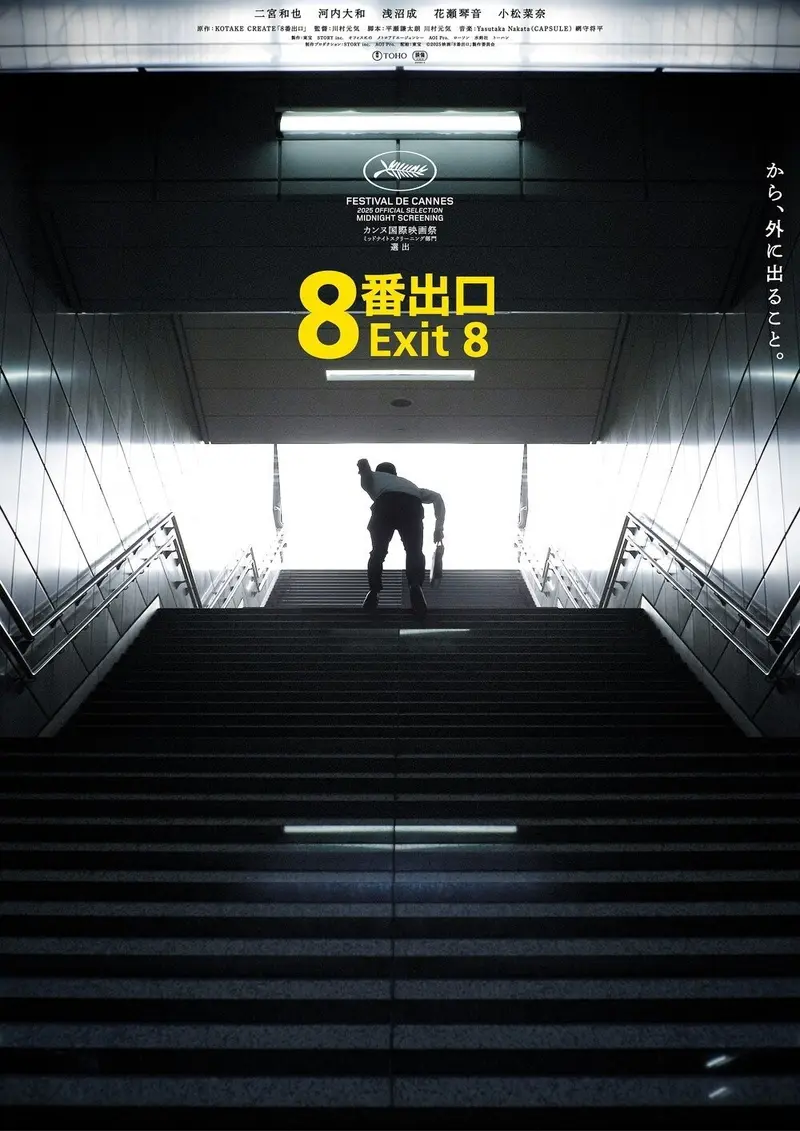
02 / The review
7 CHAPTERSHe is lost before he enters the corridor
The opening subway scene contains the key to the whole film. A man berates a woman because her baby will not stop crying. Everyone watches; no one intervenes. The protagonist simply puts his headphones back on and chooses not to become involved. Moments later, his former girlfriend tells him she is pregnant. A child's distress is no longer background noise he can mute. It may soon be his responsibility.
That gives the maze meaning without an explanatory speech. He does not know what he wants, whether he can accept responsibility or whether he would protect another person when action is required. The corridor is not the first place in which he loses direction; it merely turns his existing moral uncertainty into architecture.
Attention becomes survival
The film is at its best while the man learns the rules. White light, identical doors, familiar posters and the same briefcase-carrying pedestrian repeat with mechanical precision. Nothing is traditionally frightening, yet the demand to inspect every detail makes normality itself unstable. Was the handle always there? Did the light move? Did that man smile last time?
The most effective anomalies are therefore the smallest. Floodwater, deformed rats and sudden darkness create spectacle, but a displaced handle or a tiny movement in a poster creates deeper dread because it might pass unnoticed. The protagonist began by refusing to see another person's problem. In the corridor, failure to see becomes the punishment.
A first-person game becomes cinema
Opening in first person is an excellent adaptation choice. We enter the rules through the protagonist's eyes before we even know there is a game. When the camera later moves outside him, the world feels larger: we no longer only occupy his uncertainty but watch pressure alter his body and behavior.
That transition allows the film to retain the spirit of the game without becoming a ninety-minute recording of someone walking through a hallway. The camera, lighting and sound continually reclassify the same physical space, turning repetition into visual grammar rather than a production limitation.
The Walking Man becomes a warning
One of the adaptation's smartest additions is leaving the protagonist and following the Walking Man, whom we first assume is merely part of the loop. We discover that he too was once trying to escape, that the boy was with him and that he advanced remarkably far. What defeats him is not a monster but despair.
When he sees what he believes is a real exit, his desperation makes him ignore every sign. The once-ominous figure becomes a possible future for the hero: the endpoint of treating escape as more important than truth. Repetition does not only test observation; it erodes the will to continue observing.
The boy turns escape into responsibility
The boy pushes the film furthest from its source. Dramatically, he is essential: until then the man's objective is simply to get out. The child's presence creates a harder question—will he leave alone? The maze now tests the exact fear awakened by the pregnancy call. Can he care for a child, protect him and make decisions when another life depends on his own?
The flood sequence supplies the answer. The man who has spent the film hesitating finally chooses the boy over himself. It does not prove he will be a perfect father, and that is not the point. It proves that when the decisive moment arrives, he may stay instead of running.
Meaning grows as mystery shrinks
Connecting the boy to the protagonist's future son completes the emotional design, but it also narrows interpretation. Exit 8 is most compelling when we do not know what the place is, why it chose this man or whether its symbols are literal. The more firmly the film defines the boy, the less room remains for him to be a memory, a projection or a version of the protagonist's own childhood.
The same issue affects the second half. Once the audience understands the pattern, the film enlarges the anomalies into floods, creatures and pursuit. These developments prevent monotony but are less distinctive than the quiet terror of asking whether something tiny has changed. The film gradually moves from observation to escape, and observation was the more original horror.
Liminal space and the final human test
Production design makes a clean, ordered, brightly lit passage deeply unsettling. The space must be ordinary enough for abnormality to matter. Framing, perspective and sound keep that limited environment alive, while its stripped function—a corridor without destination, people or reliable time—turns everyday transit into a liminal prison.
The ending returns to the opening subway incident. The woman, the crying child and the angry man are there again, but this time the protagonist does not retreat behind his headphones. He intervenes. That small action proves the corridor was never merely a puzzle about reaching the number eight. The true test was the person who would come out of it.
03 / Final verdict
Final verdict
Exit 8 finds a cinematic language for a game built on repetition. Its first half is precise, unnerving and confident, transforming observation into danger and an ordinary subway corridor into a moral and psychological trap. The boy gives the journey emotional purpose, and the final return to the train completes the protagonist's movement from passive avoidance to responsibility. Yet the same emotional clarity costs the film some of its ambiguity, while increasingly large anomalies are less frightening than the minor disruptions that came before them. It is an intelligent, visually controlled adaptation whose best horror remains the possibility that the decisive change was present all along—and we simply failed to notice it.