02 / The review
8 CHAPTERSMarriage as Enola's most personal mystery
The strongest dramatic line is not Sherlock's disappearance but Enola's fear that love might become a beautiful cage. In Victorian society, marriage is not only romance; it is a legal and social structure carrying male authority. Sherlock's objection therefore reads less like an older brother's jealousy than concern that Enola could lose her name and agency inside an institution larger than either partner.
The film asks how a woman can love without vanishing, choose another person without becoming subordinate and enter a new home without leaving her mind at the door. Enola is not a shallowly nervous bride; she is trying to imagine the structure of her future. That is a compelling next stage for a heroine whose earlier victories were built on escape.
The wedding dress becomes an action costume
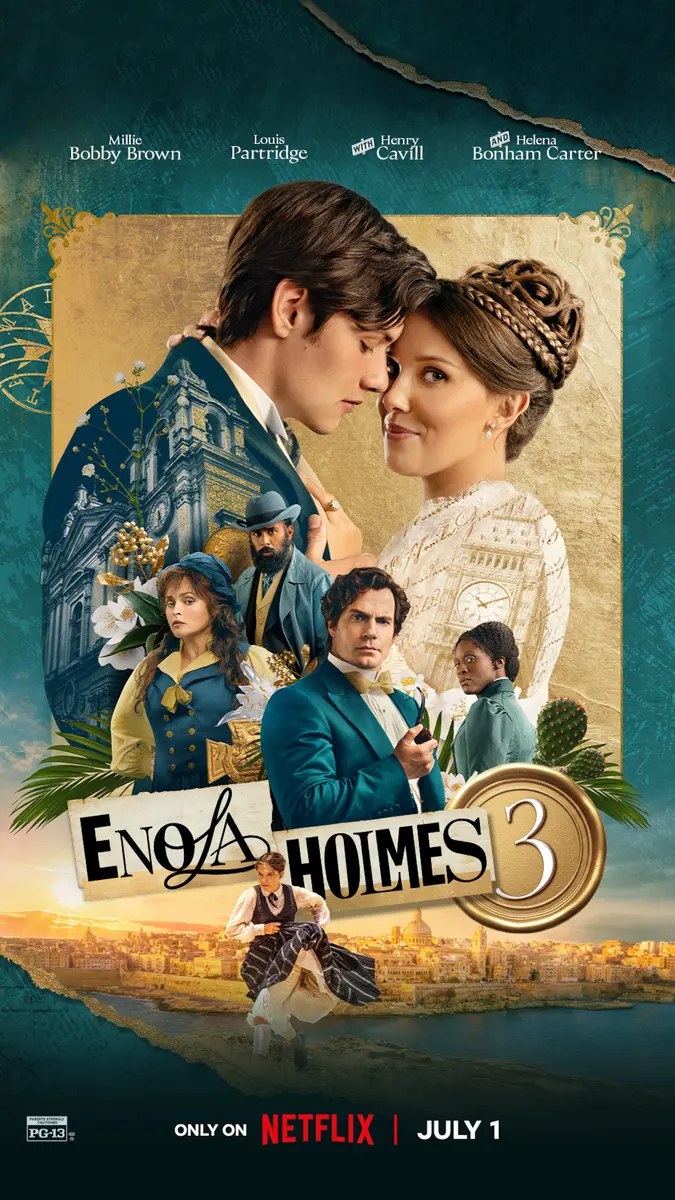
The carriage scene offers the film's best visual summary of Enola. She climbs onto it in a white wedding dress and aims a weapon at her pursuers. A garment designed to decorate and restrain becomes part of the danger. Society wants the dress to represent stillness; Enola turns it into motion. She can enter a traditional symbol without surrendering the self inside it.
Tewkesbury remains gentle and supportive. He does not ask Enola to become smaller or abandon investigation and risk; he asks to be chosen rather than fled from. Their quiet reconciliation on the Maltese beach works because it treats love as clarity, trust and repeated choice rather than good intentions alone.
A wedding cannot be the only proof of maturity
The eventual marriage remains emotionally pleasant but thematically uncertain. The trilogy has been a coming-of-age story, and Enola's adulthood should mean more than finding the correct man. The film intends to say that marriage need not erase intelligence or identity, but it risks allowing the wedding itself to look like the final certificate of growth.
An open choice might have served the character better. Enola does not need a wedding to complete her; she needs a harder case, a wider world and a decision belonging to her alone. A future installment could make marriage itself an ongoing test: can she and Tewkesbury construct a partnership different from the rules of their society rather than simply declare that they have done so?
Sherlock controls the story even while missing
Sherlock's disappearance gives Enola the lead, but also exposes the franchise's growing problem. He remains brother, legend, intellectual standard and the person who must be rescued. Henry Cavill's restrained warmth is appealing, yet the case revolves around Sherlock so completely that his world increasingly threatens to absorb hers.
Watson and Moriarty strengthen that pressure. Enola remains clever, funny and energetic, but the more classical Holmes mythology gathers around her, the less singular her own world feels. A fourth film should give her an antagonist and case that do not require Sherlock's shadow to validate their importance.
A mystery explained before we can solve it
The case begins attractively: Sherlock vanishes from his room, leaving coded traces, and Enola reads what others overlook. Morse-like fingerprints on a mirror turn an ordinary surface into a message and briefly restore the pleasure of a classical puzzle.
But the film too often distrusts its audience. Flashbacks, voice-over and emphatic framing identify clues, explain emotions and arrange each turn before viewers can participate. Detective fiction is most satisfying when we walk beside the investigator, not when we receive her summary after she has already crossed the finish line.
Colonial history gives the case ambition—and congestion
The conspiracy links the mystery to British violence in Afghanistan: stolen temple gold is moved toward Malta, cleansed of its origin and intended to rescue the British economy. That makes the crime systemic rather than personal—a nation stealing, hiding and rewriting its own theft. Malta becomes more than a sunny backdrop; its beauty contains the history of occupation and resistance.
The ambition deserves credit, but not enough space. Marriage, independence, Sherlock, Watson, Moriarty, Afghanistan, Maltese freedom and the treasure all compete for the same running time. The result is movement without always producing depth. Colonialism occasionally feels placed beside the mystery rather than integrated into its emotional mechanism.
Moriarty turns intelligence into a trap
Sharon Duncan-Brewster brings theatrical energy to the final third. Moriarty kidnaps Sherlock and Lady Tewkesbury so Enola will solve the trail and expose the hidden gold for her. The cleverness of the plan lies in using the heroine's greatest strength as the mechanism of her defeat. Enola walks toward the trap knowing it is a trap because solving it is the only way to force the enemy into view.
The confrontation with Sherlock contains the finale's strongest psychological idea. By hurting Enola in front of him, Moriarty tries to make the rational detective kill and therefore destroy his own identity. The question—can reason survive when the heart is attacked?—is more compelling than the surrounding physical struggle and deserved more time.
A handsome adventure repeating an old lesson
Malta gives the series a fresh visual body: blue sea, hard sunlight, stone streets and open horizons replace London's fog. Action is heavier and more painful than before, while costumes—especially the wedding dress—carry thematic meaning. Yet the tone shifts awkwardly between playful fourth-wall comedy and a heavier drama of empire, blood and identity.
Most damaging is the repeated lesson that Enola is not Sherlock and must value her own method. It was vital at the beginning of the series, but by the third film both heroine and audience already know it. The next chapter must move beyond comparison and trust Enola with silence, ambiguity and a case that belongs to her alone.
03 / Final verdict
Final verdict
Enola Holmes 3 is an affectionate and entertaining adventure, but not the trilogy's strongest film. Its central idea—that freedom need not mean refusing love and love need not require surrendering the self—is genuinely worthwhile. The carriage sequence, Maltese setting, Moriarty's return and the warmth between Enola and Tewkesbury all give it life. Yet the film is overloaded: a wedding story, detective mystery, revenge plot, colonial critique, Moriarty comeback and sibling drama compete for attention, while voice-over explains more than the audience is allowed to discover. Millie Bobby Brown remains the series' essential force, but Enola now needs a film that trusts her more: a deeper silence, a smarter mystery and a space beyond Sherlock's shadow.