02 / The review
8 CHAPTERSA body that no longer feels like her own
Cassandre is fourteen, at the age when her body begins to change, but the film refuses to treat that change as a routine detail in a conventional coming-of-age story. The body becomes the conflict. Family members notice her development, and the girl begins to feel that her physical self is no longer entirely hers—that other people watch it, interpret it and decide how it should be treated.
Director Hélène Merlin does not construct the drama only around what happens to Cassandre, but around the gradual way she becomes able to recognize it. We are not watching a girl who already understands everything and searches for a solution. We watch a child first trying to name her own feeling and to understand why her home makes her feel trapped. That gives the journey a painful realism and avoids the false certainty of a neatly written victim narrative.
A family made frightening by silence
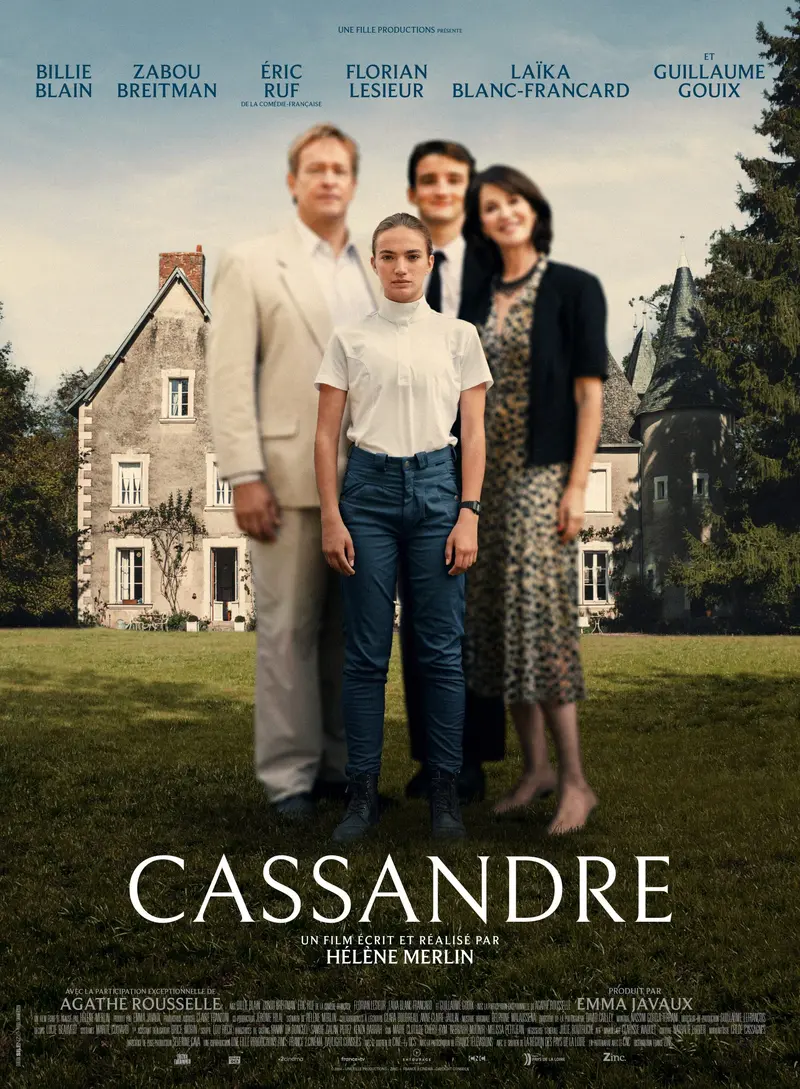
The family's presentation is one of the film's strongest elements. The father is military, authoritarian and quiet. The mother appears more permissive, while the older brother represents the home's most dangerous force. Yet the film never needs to turn them into a collection of visibly evil characters in order to make the threat felt.
The opposite is more effective. The atmosphere remains calm, the countryside is beautiful and summer looks inviting, but beneath the image lies an unhealthy relationship and a silence that allows harm to continue. The film creates psychological horror without becoming a horror movie. What frightens us is not only what is shown but what we understand is hiding behind the image. The central issue is collective silence: the danger lies not solely in the person committing harm but in an environment that allows it, normalizes it or behaves as if it must never be spoken about.
The equestrian center becomes room to breathe
Cassandre's arrival at the equestrian center is the story's most important shift, not because it radically changes the external plot but because it changes the way she sees herself. At home, she is part of a family structure that imposes an identity on her. At the center, she can begin to exist as somebody else.
There she encounters people outside the family circle, develops a more ordinary relationship with the world and discovers a degree of freedom unavailable inside the house. Horses and riding therefore become more than a hobby. The place itself is a breathing space. The film does not pretend that riding can solve the abuse, which is crucial, but uses the center as the first environment in which Cassandre can begin reclaiming herself.
Julie and the value of an ordinary safe relationship
Cassandre's relationship with Julie gives the film necessary balance. The story could easily have drowned in pain and silence, but it periodically opens a small window onto an ordinary life. Julie offers a bond not built on fear, control or surveillance. Sometimes a person does not need a complete answer before escaping a harmful environment; the first need is simply a place in which being oneself feels possible.
Her relationship with the riding instructor adds another quiet contrast. He is not written as a heroic savior, only as an adult capable of addressing her with respect and safety. That difference helps Cassandre understand that the relationships inside her family are not the only relationships that can exist.
The beauty and danger of remembering 1998
The summer of 1998 is not decorative period detail. The film uses the era to make the world feel slightly detached from the present, like an old memory. That choice matches Cassandre's psychology. Warm images, visible grain and the texture of family photographs make the film feel like a painful recollection recovered years later.
The approach is beautiful, but sometimes excessively so. The image is highly aestheticized while the subject occasionally needs greater simplicity and realism. The visual language serves the film most of the time, yet there are moments when it attracts attention to its own elegance more than it should.
Animation expresses what direct images should not exploit
One of Merlin's most important decisions is using stop-motion animation instead of depicting the assault directly. The subject is extremely sensitive, and symbolic expression avoids turning trauma into spectacle. The body becomes a puppet, expressing loss of control and separation from the self.
It is as if Cassandre can no longer feel that the body receiving the harm is her own. The method does not explain trauma through dialogue; it translates an internal fracture into an image. This is one of the film's most successful visual ideas precisely because it respects both the character and the audience.
The voice-over explains what the film can already show
The voice-over is less convincing. Cassandre's inner voice gives the story intimacy, but on several occasions it explains what the image and performance can communicate alone. The film is strongest when it leaves room for us to read the scene ourselves.
When the frame is still, faces are silent and small gestures carry the meaning, the viewer becomes a participant in understanding the experience. A voice that names the exact meaning reduces that space. Less narration would have allowed several emotions to remain inside the image and Billie Blain's performance.
Billie Blain carries the film through restraint
Billie Blain carries much of the film, a difficult task for a character who rarely depends on continuous dialogue. Cassandre is built through looks, hesitation and the way she occupies a room. The performance must avoid exaggeration without becoming blank, and Blain finds the space between those dangers. Confusion, withdrawal and the urge to escape pass across the character without always needing words.
Zabou Breitman adds complexity to the mother, whom the film refuses to define simply as evil or innocent. Her existence in this household is part of the problem, and the surrounding structure of silence makes her worth examining. The people at the equestrian center function as the family's opposite, and that contrast needs no speeches. We only need to watch how Cassandre changes when she steps outside the house.
03 / Final verdict
Final verdict
Cassandre is a sensitive and serious film whose greatest success comes from approaching its subject psychologically and humanely rather than turning it into a chain of shocking scenes. Billie Blain's performance, the contrast between a beautiful environment and a cruel family atmosphere, the use of the equestrian center as a space of self-discovery and the symbolic visual expression of trauma are its strongest elements. At times, the film is weakened by its desire to be too poetic—through images that are excessively beautified and voice-over that explains feelings better left to the viewer. Even so, the experience remains coherent whenever it stays close to Cassandre and her movement from feeling imprisoned by her family toward finding a space in which she can see herself outside that cage.
Your turn