02 / The review
7 CHAPTERSClark finds the architecture of his failure
Clark owns a Santa Clara furniture store with the absurd name Cap'n Clark's Ottoman Empire. The joke hides a ruined man: divorced, drinking, sleeping at work and still carrying the abandoned dream of becoming an architect. Instead of designing real places, he discovers a place no design can explain.
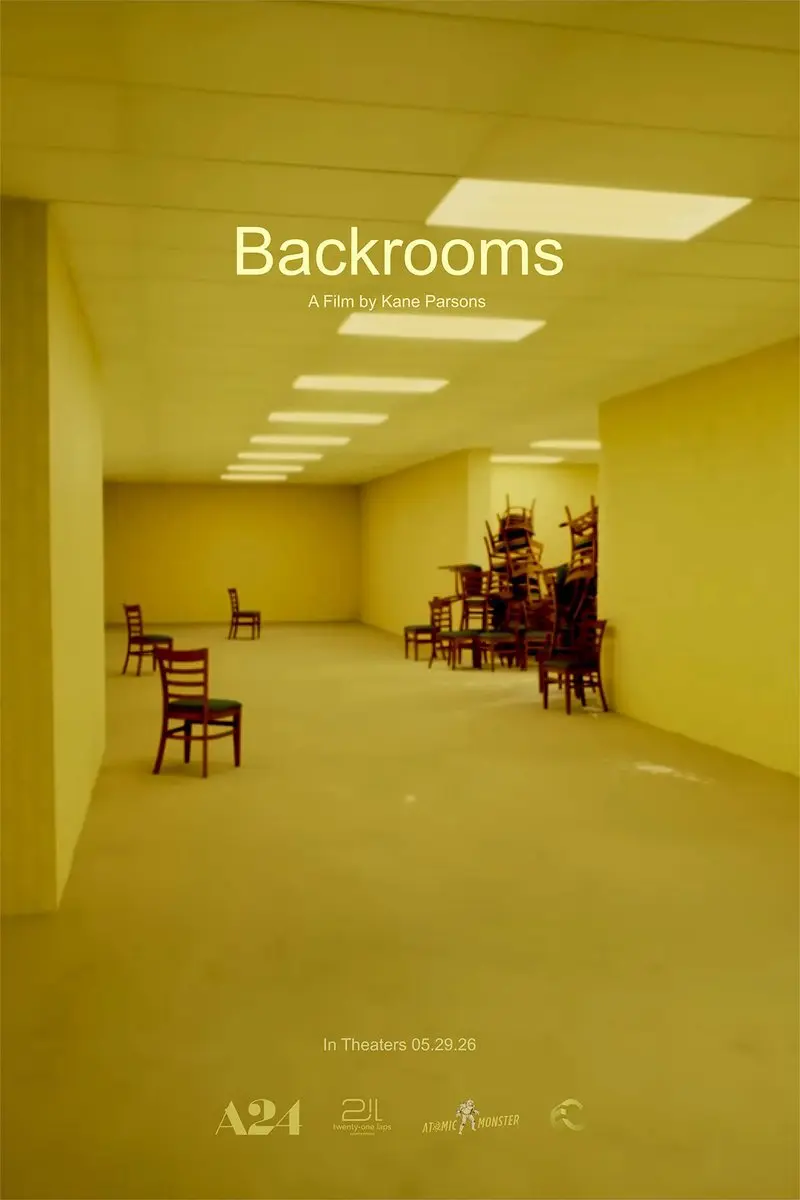
He enters the Backrooms through the basement: yellow chambers, cold fluorescent light, furniture embedded incorrectly in walls and ceilings. At first he fears it, then recognises himself in it. This world has no real relationships and asks for no emotional change. It gives his isolation architecture—and the seductive illusion that he can become master of the ruin.
A place that remembers
The Backrooms are not merely an infinite set. They observe, retain and corrupt. They take fragments from the people inside—shops, homes, clothing, faces—and reproduce them with the inaccuracy of a diseased memory. Horror comes not only from a creature but from a space learning who you are.
That makes the maze a physical model of the mind in distress: images repeat, old pain becomes geography and doors lead into distorted versions of what should have been familiar. Clark does not simply get lost in this structure. He begins to prefer it because the real world would require him to accept responsibility and change.
Mary enters a patient's world and finds her own
Dr. Mary Kline is more than a therapist summoned to rescue a patient. Her childhood home was destroyed, her mother struggled with illness and she carries an old alienation from place itself. When the Backrooms begins rebuilding pieces of her memory, she enters not only Clark's psychic space but her own.
Therapeutic language cannot solve wounds that have become walls and creatures. Mary survives through resistance, striking her pursuer with a stone from the home she lost. The symbol is direct but effective: something carried from a painful past can become an instrument of survival rather than only a burden.
Kat, Bobby and the rope into the unknown
Clark recruits employee Kat and her boyfriend Bobby to document his discovery, converting curiosity into catastrophe. Bobby descends by rope into a space full of abandoned clothing, then finds items that resemble his own—including pieces marked with blood. The scene is effective because it suggests before it explains.
A creature takes Bobby, and Kat vanishes after him, confirming that the maze is not solely a psychological metaphor but a physical predator. They serve the escalation better than they function as complete people; their loss is powerful as an event, less so as the end of two deeply developed lives.
Still Life and the copies without souls
The Still Life entities look like failed attempts to imitate human beings. Their unfinished bodies ask a simple philosophical question: if a place can copy shape, sound and memory, what remains beyond its reach? The film's answer seems to be an interior self the maze can reproduce only as distortion.
Clark uses those copies to restage his marriage with Mary, revealing that his desire has shifted from understanding to control. The largest creature wears a malformed version of Cap'n Clark, the commercial persona he built for himself. The monster is therefore not alien. It is the false mask that finally consumes its maker.
Liminal horror is strongest in the quiet
Wide compositions, sick yellow walls, fluorescent hum, distant footsteps and continuous light create claustrophobia in an open space. That paradox defines the fear: there may be infinite room, but there is no map, exit or meaningful destination. A corridor becomes more unsettling than a traditional haunted room.
Found-footage passages reconnect the film to the internet mythology that birthed it. The final act becomes less distinctive when it leans into direct monsters and conventional pursuit. Backrooms is more frightening when we hear breathing behind the wall than when the camera shows us exactly what is breathing.
Async and the danger of explaining the maze
The Async Research Institute, a 1990s tape and the scientist Naren Warne establish a history beyond Clark. The story ends his immediate arc but keeps Mary and the larger phenomenon open. That is the right instinct: completely explaining the Backrooms would shrink their terror.
Yet the psychological symbolism occasionally explains itself too clearly. Trauma, therapy and memory become verbal rather than atmospheric, reducing some ambiguity. Async also creates a promising future threat: human beings attempting to study, control and perhaps commercialise a place whose limits they do not understand.
03 / Final verdict
Final verdict
Backrooms succeeds most completely as atmosphere and idea. It turns an internet myth into cinema with a visual and sonic identity, treating the maze as a being that remembers, imitates and corrupts. Strong performances anchor its psychological dimension, while overexplicit symbolism, thin supporting characters and a more conventional final chase keep it from perfection. This is not horror built on screaming but on emptiness; not a film about an endless place so much as a person unable to escape himself. It leaves one wonderfully unpleasant question: if the place can remember us, what will it do with everything we are trying to forget?